
How to Create a Menstrual Friendly Workplace
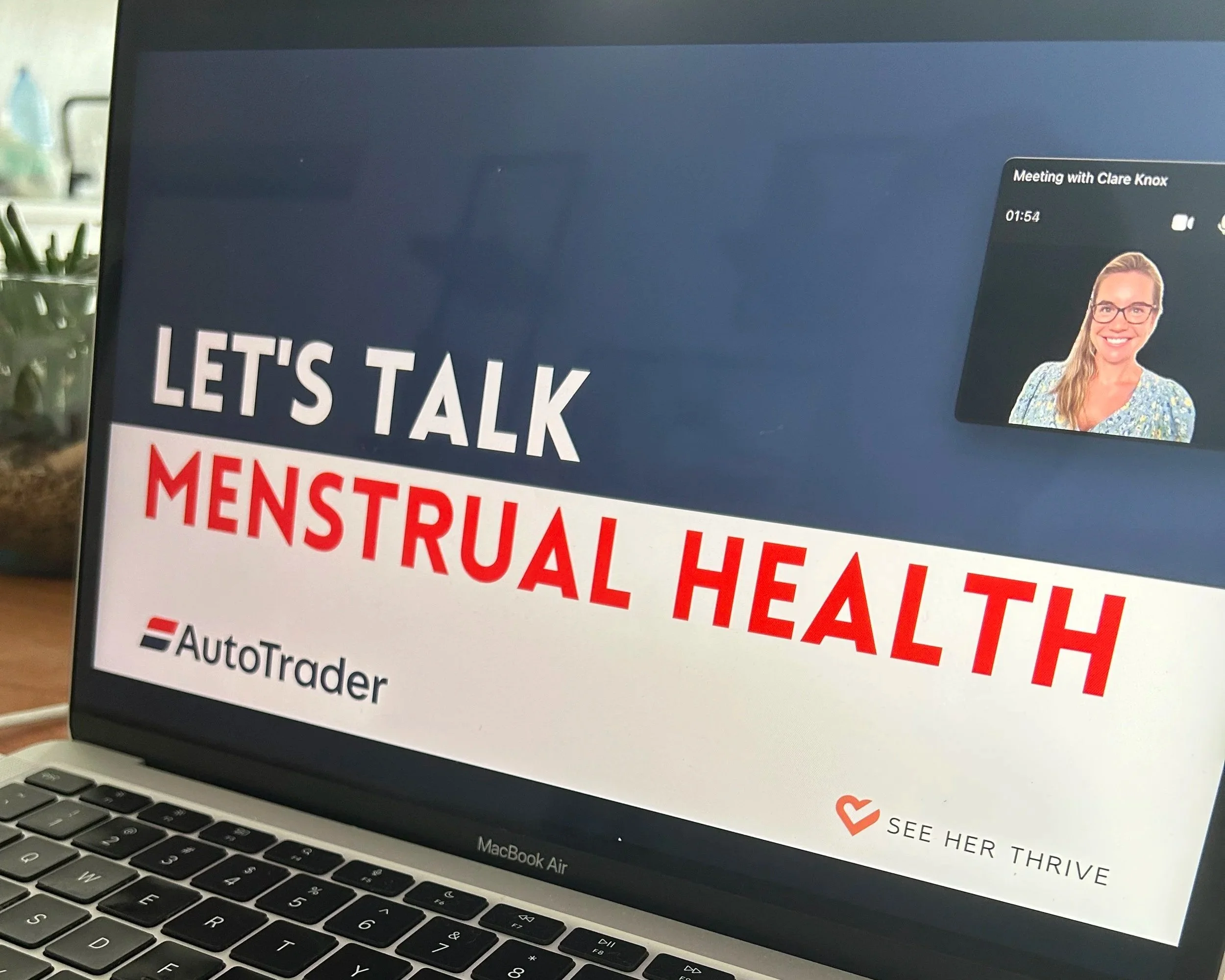
See Her Thrive delivering a menstrual health session for Auto Trader, helping make conversations about menstrual and hormonal health at work feel more normal, informed and supportive.
Menstrual health is a workplace issue, whether organisations are talking about it or not.
Every day, people are turning up to work while managing period pain, heavy bleeding, migraines, fatigue, poor sleep, brain fog, digestive symptoms, anxiety, low mood and changes in concentration. For some, these symptoms are uncomfortable but manageable. For others, particularly those living with conditions such as Endometriosis, Adenomyosis, Fibroids, Polyendocrine Metabolic Ovarian Syndrome (PMOS) or Premenstrual Dysphoric Disorder (PMDD), they can have a significant impact on day-to-day life.
And yet, in many workplaces, almost none of this is visible.
We have made huge progress when it comes to menopause at work, which is absolutely a good thing. But menstrual health still feels like the awkward younger sibling of the conversation. People are often much less comfortable talking about periods, hormonal symptoms or what happens across the menstrual cycle, even when those things are affecting how they feel and function at work.
So people manage quietly. They push through. They say they have a headache, a stomach bug or just “aren’t feeling great”. They avoid explaining why they need to work from home or why they have had to cancel something. They sit through meetings while in pain and hope nobody notices.
That silence matters.
See Her Thrive contributed to the CIPD’s research on menstrual health and support at work, which found that 69% of women who had experienced menstrual symptoms said those symptoms had negatively affected them at work. More than half had been unable to go into work at some point because of their symptoms, yet almost half of those who had taken time off said they never told their manager the real reason why.
For me, that is one of the most telling findings.
It suggests that this is not only a health issue. It is also a culture issue.
If people would rather hide what is happening than have an honest conversation with their manager, we have to ask why.
Creating a menstrual-friendly workplace is not about making periods the centre of working life, and it certainly is not about assuming that everyone with a menstrual cycle needs support. It is simply about acknowledging that menstrual and hormonal health can affect people at work, and making it easier for them to manage that without embarrassment, unnecessary stress or fear of being judged.
There are some very practical ways organisations can do this.
Start by making menstrual health less awkward
One of the most useful things employers can do is actually quite simple: talk about it.
Periods and menstrual cycles are normal, but many of us have been conditioned to treat them as something private, embarrassing or vaguely inappropriate. That does not suddenly disappear when we walk through the office door.
Even the language people use gives this away. Someone might say they are having “women’s problems”, that they feel “a bit hormonal”, or simply that they are unwell, because saying “my period pain is really severe today” still feels too exposing.
The trouble is that when something is never talked about, asking for support can feel like a much bigger deal than it needs to be.
A menstrual-friendly workplace is not one where everyone is expected to discuss their cycle openly. That would be just as unhelpful. It is one where somebody who does need to raise an issue can do so without feeling like they are saying something shocking.
Education can help enormously with this. A good awareness session can help people understand how the menstrual cycle works, what symptoms can look like, and how conditions such as PMDD, endometriosis, adenomyosis and PMOS can affect someone physically, psychologically and cognitively.
And importantly, this should not only be education for women. If we want menstrual health to feel normal at work, everyone needs enough understanding to be part of the conversation.
Train managers to have normal, human conversations
There is no point telling employees that it is safe to speak up if the manager on the other side of the desk is visibly panicking.
For many managers, the problem is not that they do not care. It is that they have never been taught what to do. They worry about saying the wrong thing, asking something inappropriate or opening a conversation they are not qualified to have.
So they avoid it.
Or they move too quickly into problem-solving.
Or they say something well-meaning but unhelpful, like “Have you spoken to your doctor?” and unintentionally shut the conversation down.
Managers do not need to diagnose anything. They do not need to understand every hormonal pathway or know the difference between every menstrual health condition.
They need to know how to listen, how to respond without judgement, how to maintain confidentiality and how to ask a simple question such as, “What would help you at work right now?”
That question can go a very long way.
For one employee, the answer might be working from home on a particularly difficult day. For another, it could be more frequent toilet breaks, flexibility around travel, a later start after a sleepless night or simply knowing they can say, “Today is a bad day,” without having to give a ten-minute explanation.
The best support is often far less complicated than organisations imagine.
Build in flexibility before someone has to beg for it
Many menstrual and hormonal health conditions fluctuate. Someone can feel absolutely fine one week and really struggle the next.
That does not make them inconsistent. It means their health changes.
Rigid workplaces make that much harder to manage.
If someone has been up most of the night with severe pain, starting at 10 rather than 9 might make a huge difference. If someone is experiencing very heavy bleeding, being able to work from home can remove the stress of a commute and constant anxiety about access to a toilet. If someone experiences severe premenstrual symptoms, reducing unnecessary travel or shifting a non-urgent meeting can help them work far more effectively.
None of this means lowering standards.
Quite often, it is the opposite.
A little flexibility can be the difference between somebody being able to work well and somebody spending the entire day trying to survive it.
This is why good menstrual health support often looks very similar to good job design. Flexibility, autonomy and trust tend to help lots of people, not only those managing hormonal health issues.
Look at the workplace itself
Some of the most important changes are also the least glamorous.
Can people easily get to a clean, private toilet?
Are there bins in every cubicle?
Do people have enough time to use the bathroom without worrying that somebody is tracking how long they have been away?
Are period products available if somebody is caught out?
Can somebody access drinking water, somewhere to sit comfortably, or a bit of privacy if they are feeling unwell?
These things sound small until you are the person who needs them.
Someone dealing with heavy bleeding should not have to walk across three floors to find a bathroom. Someone with endometriosis or adenomyosis should not feel guilty for needing to stand up, stretch or take a short break because sitting has become painful.
We can talk about culture and policy all day, but the physical environment still matters.
Make period products a basic provision
This one really should be easy.
If a workplace provides toilet roll, soap and hand towels, period products should not feel like an extravagant extra.
Periods can arrive unexpectedly. Cycles change. People forget things. Bleeding can be heavier than usual. And trying to find a tampon or pad when you need one urgently is stressful in a way that is completely avoidable.
A simple supply of pads and tampons in bathrooms can make a real difference.
And please do not lock them in a cupboard or keep them behind reception.
Nobody should have to announce to a receptionist that they have started their period before they can access a basic product.
Just put them in the bathroom.
Review the policies people actually experience
A beautifully written menstrual health policy is not much use if nobody knows it exists or managers do not know what to do with it.
Some organisations will benefit from having a specific menstrual health policy. Others may prefer to include menstrual and hormonal health within existing wellbeing, sickness absence, flexible working and reasonable adjustment frameworks.
Either approach can work.
The more important question is whether the employee experience makes sense.
If somebody’s symptoms affect their attendance, do they know who to speak to?
If they need an adjustment, is there a clear route to requesting one?
If a manager wants advice, do they know where to go?
And if somebody experiences recurring absence because of an ongoing health condition, is the absence process flexible enough to recognise that context?
This is where organisations can get caught out. A policy might look neutral on paper but have a very different impact in practice.
A rigid trigger system, for example, can end up penalising somebody whose health condition causes short but recurring absences, even when those absences are entirely legitimate.
Good policy is not about removing accountability. It is about making sure processes are being used sensibly.
Make it easier to access healthcare
For many people, getting help with menstrual health is not quick.
They may spend months or years trying to understand what is happening, particularly with conditions such as endometriosis, adenomyosis, PMDD or PMOS. There can be repeated GP appointments, scans, blood tests, medication reviews, specialist consultations and long waits for referrals.
All of that happens alongside work.
Employers cannot fix waiting lists or healthcare systems, but they can decide whether getting medical help becomes another source of stress.
A bit of flexibility around appointments can make a huge difference. So can access to occupational health, specialist women's health support or private healthcare benefits that actually cover the issues employees are dealing with.
It is also worth reviewing what your health insurance includes rather than assuming “women's health” is automatically covered in any meaningful way.
Sometimes the most supportive thing an organisation can do is make it easy for someone to attend an appointment without feeling like they are causing a problem.
Stop assuming every menstrual cycle looks the same
There is no single experience of a menstrual cycle.
Some people have very few symptoms. Some have significant symptoms. Some have very predictable cycles. Others have no idea when their next period will arrive. Some mainly experience physical symptoms. Others experience profound changes in mood, cognition or energy.
And some people simply do not want to think about their cycle very much at all.
That matters because, as menstrual health has become more visible, we have also seen a rise in very simplistic advice about “cycle syncing” and structuring work around different hormonal phases.
Some people find cycle awareness genuinely useful, and that is absolutely fine. But it should never become another set of rules about what women are supposedly good at at different points of the month.
We have spent enough time dealing with stereotypes about women being “too hormonal” without creating new ones in the name of empowerment.
Give people information. Let them decide what is useful. Trust them to understand their own body.
Think bigger than periods
Menstrual health is not just about bleeding.
Conditions such as PMDD, endometriosis, adenomyosis, fibroids and PMOS can affect someone across the whole month. Symptoms can include pain, fatigue, cognitive changes, sleep disturbance, low mood, anxiety and a host of other physical and psychological effects.
People may also be dealing with fertility concerns, medication side effects, hormonal treatments, surgery or investigations alongside their normal workload.
And of course, menstrual health does not exist in a vacuum. It overlaps with fertility, pregnancy, postpartum health, perimenopause and menopause, as well as wider mental and physical health.
This is why I think the most progressive organisations are moving beyond one-off initiatives.
A menopause policy is useful. Period products are useful. A lunchtime webinar is useful.
But the bigger question is whether the organisation understands women's health as part of the employee experience.
Are managers equipped? Are policies fair? Is work designed with enough flexibility? Do people feel safe to speak? Are women's health issues taken seriously before somebody reaches breaking point?
That is where real change happens.
Focus on the culture, not the badge
There are now accreditation and certification programmes available for organisations that want to demonstrate their commitment to menstrual health at work. We have deliberately chosen not to offer one ourselves.
That is not because we think standards or accountability are unimportant. Quite the opposite. From an organisational psychology perspective, our focus is on what actually changes the day-to-day experience of people at work. A policy can exist without anyone feeling safe enough to use it. Training can be completed without managers changing the way they respond. An organisation can introduce a number of visible initiatives while the underlying culture stays exactly the same.
For us, the more important question is not whether an organisation can call itself menstrual-friendly. It is whether employees would experience it that way.
Do people feel able to talk about their health without being judged? Do managers know how to respond? Are policies and processes genuinely supportive in practice? Is flexibility available when somebody needs it? Are people noticing a meaningful difference in their experience of work?
That is why our approach is less about working towards a badge and more about helping organisations understand what is happening now, identify the barriers that exist in their particular workplace and make changes that are meaningful, measurable and sustainable over time.
The biggest shift is trust
Ultimately, a menstrual-friendly workplace is one where people do not feel they have to prove that they are struggling.
They should not have to justify why their pain is bad enough, why their fatigue is real or why working slightly differently for a day would help.
Of course organisations need consistency and boundaries, but those things can coexist with common sense and compassion.
If somebody tells you they are struggling, believe them.
If a relatively small adjustment would help them stay well and do their job, explore it.
And if somebody is repeatedly struggling, look beyond the individual and ask whether something about the role, workplace or culture could be making things unnecessarily difficult.
That is what menstrual-friendly working looks like to me.
It is not really about periods at all.
It is about creating human workplaces that understand people have bodies, health changes, hormones fluctuate and life does not always fit neatly into a nine-to-five schedule.
When organisations understand that, menstrual health stops being an awkward “women's issue” and simply becomes part of being a good employer.
Want to improve menstrual health support in your organisation?
At See Her Thrive, we help organisations understand how menstrual and hormonal health can affect people at work and, more importantly, what good support looks like in practice.
Through talks, workshops, manager training and consultancy, we help organisations build knowledge, improve conversations and create working environments where women can thrive throughout their working lives.
Whether you are just starting to think about menstrual health or want to take a more strategic look at women's health across your organisation, we can help.
Explore our services or get in touch to talk about what support could look like for your organisation.