
Who Owns Women’s Health at Work? When Everyone Is Involved but No One Is Accountable

I was talking recently to a friend who works in a large global organisation, and she said something that really got me thinking. One of the problems they are having with women’s health is actually quite a basic one: nobody really knows who owns it.
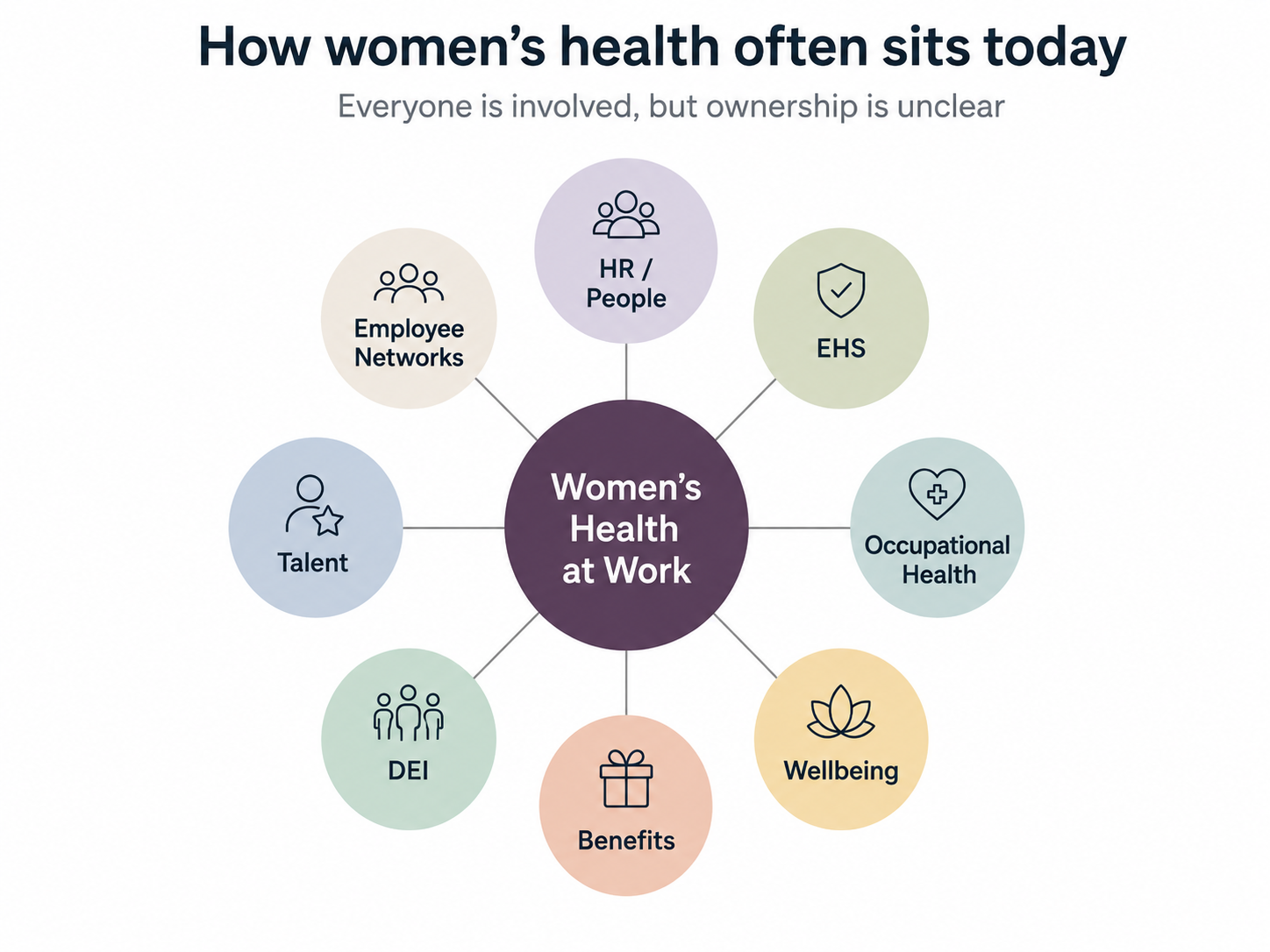
It sits somewhere between HR and EHS. Wellbeing are involved. The women’s network are doing things. There may be input from Occupational Health, Benefits or DEI. But when you ask who is ultimately responsible for bringing all of that together, deciding what the organisation is trying to achieve and making sure there is a clear plan, it becomes much harder to answer.
I suspect this is happening in a lot of organisations, and it is not necessarily because nothing is being done. Often, quite a lot is happening. A women’s network might organise an event on endometriosis or PMDD. The wellbeing team commissions a menopause workshop. HR introduces a policy. Somebody trains a group of champions. Occupational Health supports individual cases and Benefits introduces a new healthcare service.
Taken individually, some of these things can be excellent. The problem is that they are often happening independently of one another, without anyone standing far enough back to ask what the organisation is actually trying to change. Who understands the starting point? Who knows what women across the organisation are experiencing? Who decides where the priorities should be? Who makes sure the different pieces connect, and who is looking six or twelve months later to see whether any of it has actually made a difference?
Very often, I am not sure anyone is.
When something touches several different functions, it is easy for everyone to be involved without anyone really being accountable for the whole thing. And I think that is where a lot of workplace women’s health strategies are getting stuck.
Women’s health has largely grown from the ground up
A lot of workplace women’s health activity has developed in a grassroots way, and there is something really positive about that. Women have started conversations that simply were not happening before. Employee networks have pushed menopause, menstrual health, fertility and reproductive health onto organisational agendas. People with lived experience have shared their stories, built communities, found speakers, created resources and offered support to colleagues who may otherwise have had nowhere to go.
Some of the most meaningful change I have seen has started because one person cared enough to say, “We need to do something about this.”
But there comes a point where grassroots energy needs to become organisational responsibility.
I know several women who have effectively become the women’s health person in their team or organisation simply because they have lived experience or developed an interest in the subject. Colleagues come to them for advice. They organise sessions, answer questions, signpost people towards services, advocate for better support and sometimes end up having quite difficult and emotionally loaded conversations with women who are struggling.
Much of that is happening alongside the job they are actually employed and paid to do. There may be no protected time, no formal recognition and no additional pay, despite the organisation benefiting enormously from their knowledge, emotional labour and initiative.
That makes me uncomfortable, particularly when the organisation has started to rely on those individuals.
Employee networks and passionate volunteers can be a brilliant part of this work, but they should not become the infrastructure holding it together. They usually do not have the authority to change policies, allocate budgets, redesign jobs, influence leadership pipelines or hold senior leaders accountable anyway. If the whole thing depends on one or two enthusiastic people continuing to push it forward in their spare time, we have not really embedded women’s health into the organisation. We have built it on goodwill.
And goodwill is fragile. People change jobs. They get busy. They burn out. Their priorities change. The momentum disappears and twelve months later somebody wonders what happened to the programme.
There can be lots of activity without much strategy
This is probably the pattern I see most often. An organisation can list quite a lot of women’s health activity, but when you start asking why those particular things were chosen, the answer can become surprisingly vague.
Was manager training introduced because women said conversations with their managers were a problem, or because manager training seemed like something a menopause programme should contain? Were champions created because there was a clear role for them within a wider strategy, or because other companies were training champions? Was a new fertility benefit introduced because employees were asking for it, or because it had become a visible part of the employer benefits market?
I do not say that cynically. Organisations are constantly responding to new research, changing expectations and developments in the market, and there is nothing wrong with trying something new. But there is a difference between being responsive and being reactive.
Without understanding the starting point, it becomes very easy to spend a surprising amount of money doing things without knowing whether they address the problems women in that particular organisation actually have. October comes around and somebody books a menopause speaker. March brings Endometriosis Awareness Month. International Women’s Day needs an event. Someone sees another organisation doing something interesting on LinkedIn and asks whether they should have one too.
By the end of the year, a lot may have happened. There have been events, campaigns, policies and training sessions, but nobody can really answer the question I care about most: has women’s experience of working here actually improved?
That is where the absence of ownership starts to show. Activity gives the impression of progress, but without a clear view of what you are trying to change, it is difficult to know whether you are moving anywhere at all.
So where should women’s health actually sit?
This is where the answer gets a little more complicated, because I do not think women’s health can simply be handed to HR and considered solved. It genuinely does cut across different parts of an organisation.
Occupational Health and EHS clearly have an important role because we are talking about health, workplace risk, adjustments and the interaction between someone’s health and their working environment. HR and People teams are involved because policies, absence, flexible working, employee relations and manager capability matter enormously. Wellbeing teams have a role in education and access to support, while Benefits teams influence healthcare provision. DEI may be looking at equity and differences in employee experience.
But there is another part of the organisation that I think is noticeably absent from many of these conversations: Talent.
That feels like a significant gap.
If women’s health can influence whether someone applies for a promotion, feels able to take on a bigger role, reduces her hours, stays with an organisation or sees that organisation as somewhere she can build a long-term career, then it is clearly a talent issue. It affects attraction, progression, leadership pipelines, retention and employer brand.
I think we still tend to underestimate that connection because “women’s health” immediately gets categorised as wellbeing. Yet from an employee perspective, the experience is not neatly divided into organisational functions. A woman does not experience one part of her menopause through Wellbeing, another through Talent and another through HR. She simply experiences work.
If she needs an adjustment, worries that asking for it will affect her progression, cannot access the healthcare she needs and has a manager who does not know how to respond, that is one employee experience. The fact that responsibility for those things is scattered across four internal teams is an organisational design issue, not hers.
This is why I do not think one function should own women’s health in the sense of being expected to deliver everything. But somebody absolutely needs to own the overall strategy.
Shared responsibility still needs clear accountability
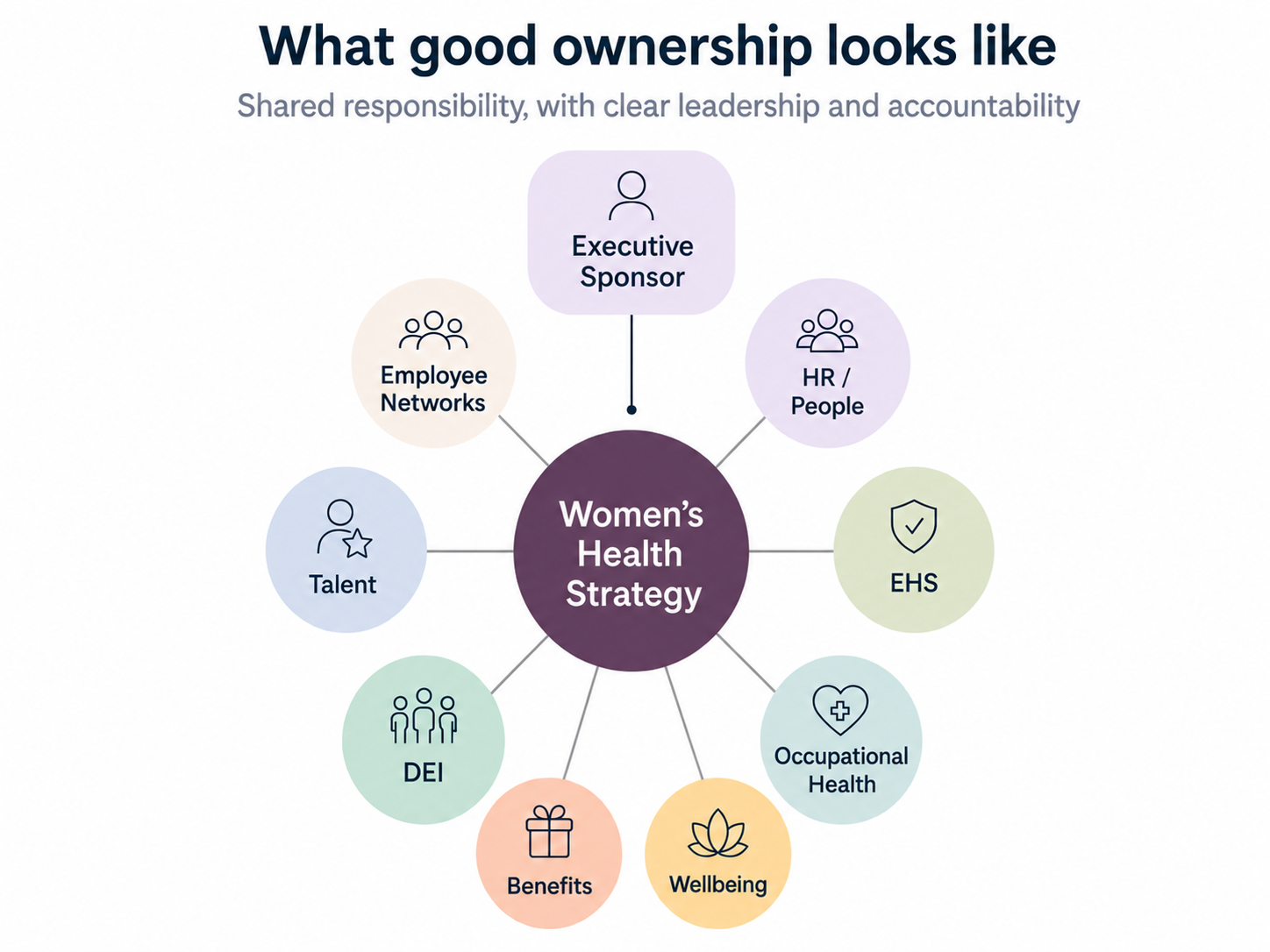
For a large organisation, I would want to see an executive sponsor as a minimum. That might be the Chief People Officer, CHRO or another senior leader with enough influence to keep women’s health visible at leadership level, unlock resources when they are needed and challenge the organisation when things are not moving.
The exact title matters less than the seniority and commitment behind it.
But executive sponsorship on its own is not enough either. Somebody also needs day-to-day responsibility for coordinating the work. They do not need to personally deliver every initiative, approve every event or micromanage what different teams are doing. Their job is to hold the whole picture.
They understand where the organisation is starting from and what it is trying to achieve. They know what is already happening across different functions. They bring the right people together, spot gaps and duplication, make sure actions have owners and keep checking whether the work is producing the intended results.
Around that person, I would want a genuinely cross-functional approach. The women’s network can bring insight and challenge from lived experience. Occupational Health can bring workplace health expertise. HR can look at policy and people processes. Talent can look at attraction, progression and retention. Benefits can examine healthcare access. Wellbeing can support education, and managers can feed back what they are actually seeing in their teams.
That feels much closer to the answer for me: shared responsibility, but clear accountability.
Otherwise, collaboration can become a very nice way of saying that nobody is ultimately responsible if nothing happens.
Leadership support is still the missing piece
The bigger issue underneath all of this is leadership.
So much of the momentum around women’s health at work is still coming from the bottom up. There are brilliant networks, passionate champions and individual managers pushing things forward because they care, and I would never want organisations to lose that energy.
But there is a ceiling to what bottom-up change can achieve when the systems above it remain untouched.
A women’s network can encourage people to talk openly about menopause, but it cannot guarantee that the manager receiving that disclosure knows how to respond. A wellbeing team can run an excellent session on menstrual health, but it cannot compensate for an absence process that makes someone frightened to take time off when she is genuinely unwell. An organisation can train twenty champions, but if those people have no protected time, no senior sponsor, no clarity about what happens after the training and nobody checking whether the initiative is working, it is hardly surprising if momentum fades.
That is not a failure of the champions. It is a failure to create the conditions around them that allow the work to succeed.
We talk about culture a lot in this space, but sometimes in quite an abstract way. Culture is not simply whether people feel comfortable talking about menopause. It is what leaders pay attention to, what gets funded, what managers are held accountable for, whose work gets recognised and what people learn matters by watching what the organisation actually does.
If women’s health is strategically important, leadership needs to treat it like something strategically important. It cannot remain something women push upwards from the edges of the organisation while senior leaders cheer them on from a distance.
We need to stop starting with the solution
Perhaps one of the simplest changes organisations could make is to stop beginning with the question, “What should we do about women’s health?”
I would start with, “What is actually happening here?”
Before deciding that you need champions, a policy, a menopause café, a benefits platform or another webinar, find out. Speak to women. Look at the data you already have. Understand the different experiences across your workforce and where your existing systems may be helping or getting in the way.
Women working in a head office may have completely different needs from women working on a manufacturing site, in a laboratory, in retail, in healthcare or out in the field. Flexible working may technically exist but be much harder to access in some teams than others. The organisation may have an excellent policy that nobody knows about, or employees may know exactly what support exists but not trust their manager enough to ask for it.
Perhaps the biggest problem is manager confidence. Perhaps it is access to healthcare. Perhaps women in midlife are quietly stepping away from senior roles. Perhaps your biggest gap is actually menstrual health among younger employees and has very little to do with menopause.
You cannot know until you look.
I am a big believer in starting with insight, not because every organisation needs a six-month research project before it can do anything useful, but because the quality of an intervention depends on whether you understand the problem you are trying to solve.
There is very little value in training 50 champions if women tell you the real barrier is that their managers will not allow flexibility. There is equally little point rewriting a policy if employees think the policy itself is fine but do not trust what will happen if they use it.
Understanding the starting point makes it possible to spend money much more intelligently too. Instead of collecting initiatives, you can make choices. You can decide what matters now, what can wait and what is unlikely to make much difference in your particular organisation.
That is not overcomplicating women’s health. It is about being strategic.
Perhaps “women’s health” is too small a label for what we are talking about
The more I think about the ownership problem, the more I wonder whether the terminology itself is partly responsible.
“Women’s health” sounds like wellbeing. And when something sounds like wellbeing, it is very easy to place it with the wellbeing team, commission some educational sessions and feel that the subject is being covered.
But what we are actually talking about is much, much bigger than that.
Health can affect how somebody experiences work, how confident she feels, what career decisions she makes and what she needs from her manager. It can affect whether women progress into leadership, whether they remain in demanding roles and whether they choose to stay with an employer. It interacts with job design, psychological safety, workplace culture, healthcare access, management capability and talent strategy.
It influences employee experience from recruitment right through to exit.
So perhaps a more useful framing is women’s health, performance and leadership at work.
I do not mean performance in the narrow sense of trying to squeeze more productivity out of women. That is not the point at all. I mean recognising that health is part of being human and inevitably interacts with how we work, how we lead and the choices we make about our careers.
Once you look at it through that lens, it becomes much harder to dismiss women’s health as a niche wellbeing initiative.
It starts to look like an organisational effectiveness issue.
And perhaps that is exactly why it needs senior ownership.
Maybe organisations don’t need more activity. They need more coherence.
I don’t think most large employers necessarily need another women’s health initiative. Many are already doing plenty.
What is missing is often the thread connecting everything together.
Someone needs to understand the starting point and hold a view of where the organisation is trying to get to. There needs to be enough leadership support to remove barriers, enough coordination to stop different teams operating in isolation and enough accountability to keep the work moving once the initial enthusiasm has faded.
Women’s networks still have an incredibly important role in that. So do champions, wellbeing teams, HR, Occupational Health, Talent and Benefits. But those things should sit within something bigger rather than existing as separate islands.
And perhaps most importantly, passionate women should not be expected to carry organisational change on top of their day jobs simply because they are the people who care the most.
That is probably the shift I would most like to see over the next few years. Less reliance on grassroots goodwill and more organisational commitment. Less jumping from initiative to initiative and more understanding of what the organisation is actually trying to change. Less asking who can organise the next event and more clarity about who is accountable for women’s experience of work.
Because if we genuinely believe women’s health influences employee experience, talent, leadership and performance, then it deserves the same discipline we apply to any other organisational priority that matters. We understand where we are now, decide where we want to go, give somebody responsibility for moving the work forward, resource it properly and keep checking whether anything is actually changing.
The grassroots movement has done an extraordinary job of getting women’s health onto the workplace agenda. But it should not have to carry it forever.
At some point, the organisation itself has to pick it up.
Ready to move from activity to strategy?
If women’s health currently sits across different teams in your organisation, with lots happening but no clear ownership or overall plan, we can help you bring it together.
At See Her Thrive, we work with organisations to understand the starting point, identify the biggest barriers for women, and turn disconnected initiatives into a clear, practical strategy that links women’s health with employee experience, leadership, talent and performance.
That might mean reviewing what is already in place, gathering insight from women across the organisation, clarifying ownership and accountability, or building a longer-term roadmap for change.
Get in touchto talk about your women’s health strategy and how we can help.