
What is a Menopause Action Plan? (And Why I Think We're Asking the Wrong Question)
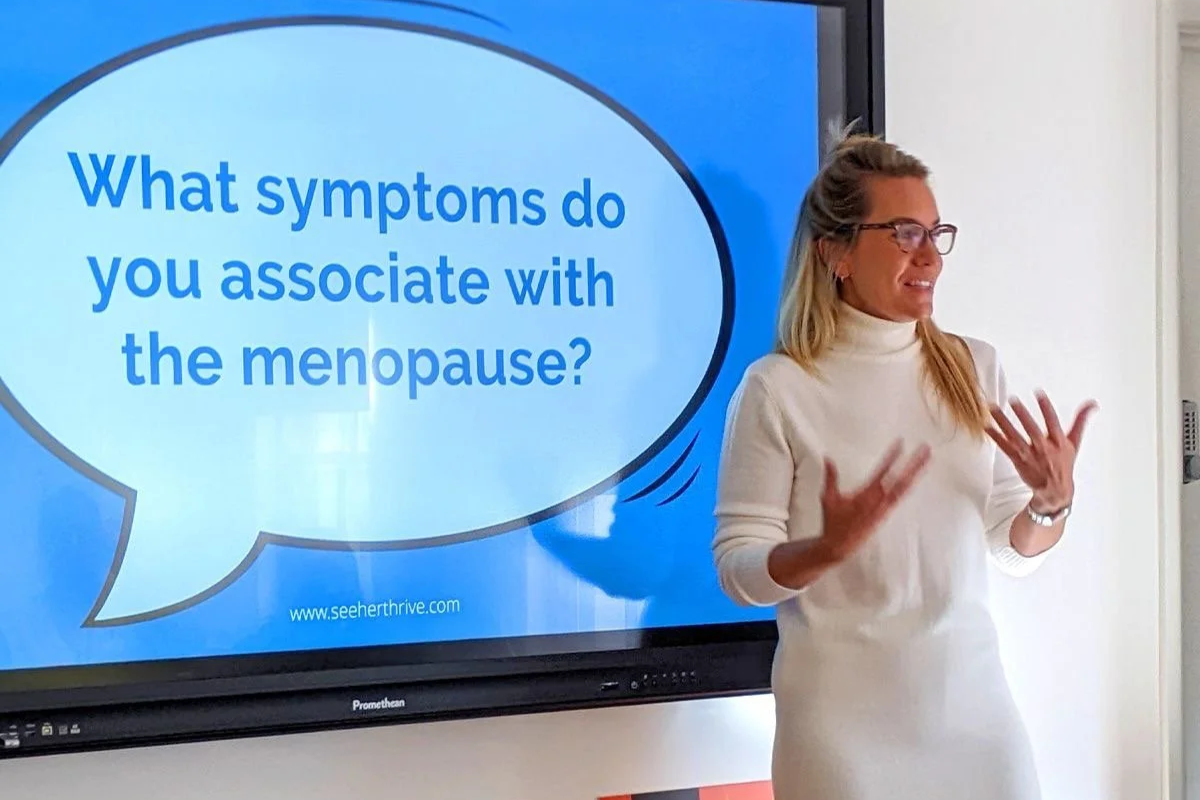
I've been thinking a lot about Menopause Action Plans recently.
Not because I think they're a bad idea. Quite the opposite, actually. I can see exactly why they're being introduced and, in many ways, I think they're a really positive step. If they encourage organisations to think more deliberately about how they support women at work, then I'm all for them.
What I've found myself wrestling with is something slightly different.
Over the last few months I've noticed the conversation changing. Organisations that, until recently, were asking how they could create a better experience for women at work are now asking how they create a Menopause Action Plan. At first glance those questions sound almost identical, but I don't think they are.
One starts with women. The other starts with a document.
As an organisational psychologist, that difference matters because documents don't change workplaces. People do. Conversations do. Leadership does. Culture does. A document can support those things, but it can never replace them.
That's why I think we're in danger of asking the wrong question.
Rather than asking whether we have a Menopause Action Plan, I think we should be asking what we're actually trying to achieve. If the answer is simply, "Because the Government says we should have one," I suspect we'll end up with exactly the sort of well-intentioned initiative that quietly disappears into a shared drive and is never thought about again.
If, on the other hand, the answer is that we genuinely want women to feel more supported, more understood and better able to thrive at work, then I think Menopause Action Plans could become something really valuable.
That's the conversation I think we should be having.
Before we talk about what a Menopause Action Plan should look like, though, it's worth taking a step back and understanding why they're appearing in the first place.
So, what actually is a Menopause Action Plan?
At its simplest, a Menopause Action Plan is exactly what it sounds like: a plan that sets out the practical steps an organisation will take to better support employees experiencing menopause.
Under the UK Government's proposals, employers with 250 or more employees will publish one alongside their Gender Pay Gap report, setting out not just their commitment to supporting women, but the specific actions they'll take to make that commitment a reality. Subject to legislation, this is expected to become part of Gender Pay Gap reporting from Spring 2027.
I actually think that's an important distinction.
For years, organisations have talked about supporting women's health at work. Many have introduced menopause policies, marked awareness days, shared resources or delivered manager training. Some have done this incredibly well. Others have done it because it felt like the right thing to do at the time. Either way, much of the conversation has centred on showing that something is happening.
A Menopause Action Plan asks a slightly different question.
Instead of asking, "Do you care about menopause?" it asks, "What are you going to do, who's responsible for making it happen and how will you know whether it's worked?"
To me, that's a much more useful conversation because it shifts the focus away from intention and towards accountability. Rather than talking about menopause in broad terms, organisations are encouraged to think carefully about the practical changes they'll make, how those changes fit within the wider business and how they'll know whether they're making a genuine difference to women's experience at work.
In many ways, I think that's exactly what organisations need. Not more awareness for awareness' sake, but a clearer sense of responsibility for turning good intentions into meaningful action.
Perhaps that's why I feel so conflicted about Menopause Action Plans. I genuinely think they have the potential to improve women's experience of work. I just don't want to see organisations mistake producing a document for producing change. Those two things are very different, and if we're not careful, we'll end up measuring the wrong thing.
Because writing the Action Plan isn't the work.
It's simply the point at which the real work begins.
This is where I think organisations need to slow down
One of the things I love most about organisational psychology is that it constantly encourages us to look beyond the obvious solution. When something isn't working, our instinct is usually to ask, "What should we do?" It's a perfectly reasonable question, but I've learnt over the years that it's not always the most helpful one.
A better question is often, "What's actually going on here?"
That might sound like a subtle difference, but I think it's the difference between creating a Menopause Action Plan that genuinely improves women's experience of work and one that simply demonstrates you've done something.
I've lost count of the number of conversations I've had with organisations that were convinced they needed manager training, a new policy or an awareness campaign. Quite often they were right. Just as often, though, they were trying to solve the wrong problem.
Every organisation is different. Every workforce is different. Even organisations operating in the same sector can face completely different challenges.
One organisation might have excellent policies on paper, but managers who don't feel confident enough to have supportive conversations. Another might have managers who genuinely want to help, yet women who don't feel psychologically safe enough to ask for support. A third might discover that menopause isn't actually the issue employees are talking about most. Perhaps they're far more concerned about menstrual health, fertility, pregnancy loss or simply feeling that women's health isn't understood more broadly.
If those three organisations all produced the same Menopause Action Plan, I'd be asking some fairly difficult questions.
People problems rarely have one-size-fits-all solutions.
That's why I think the most valuable part of creating a Menopause Action Plan happens long before anyone opens a blank document. It starts by listening. Listening to women, to managers and to the organisation itself. Looking honestly at what's already working, where the gaps are and whether the barriers are practical, cultural or structural. Gathering evidence rather than relying on assumptions.
Only then do I think you're in a position to decide what belongs in your Action Plan. Otherwise, you're simply choosing solutions before you've properly understood the problem.
Why this matters
It's tempting to think the quality of a Menopause Action Plan comes down to how well it's written. I don't think it does. A beautifully written document can still miss the point entirely if it's built on assumptions, borrowed from another organisation or created without a clear understanding of what women are actually experiencing.
For me, the quality of an Action Plan comes down to the quality of the thinking behind it. The strongest plans aren't necessarily the longest or the most polished, and they certainly aren't the ones with the biggest list of commitments. They're the ones that reflect the reality of the organisation they've been written for. They acknowledge what's already working, where the gaps are, what employees are asking for and where the organisation can make the greatest difference.
That's also why I'm cautious about generic templates.
I'm not against them. They can be a useful starting point, especially for organisations wondering where to begin. The problem comes when the template replaces the thinking.
If the first question is, "What should our Menopause Action Plan say?" it's very easy to end up with a document full of sensible-sounding actions that may or may not be relevant to your workforce. Manager training. Awareness campaigns. Policy reviews. Flexible working. Better signposting. All of those things can be valuable, but none of them are automatically the right answer.
I'd much rather organisations started with a different question.
"What do our people actually need?"
It's a deceptively simple question, but it changes everything. It shifts the focus away from producing the right-looking document and towards understanding the reality of women's experience in your organisation. It creates space to ask what's getting in the way, where managers feel stuck, what support already exists and what would genuinely make work healthier, more sustainable and more inclusive.
Once you understand that, the Action Plan almost starts to write itself. You're no longer guessing. You're making informed decisions based on evidence rather than assumptions, and every action has a clear purpose because it's responding to a real need.
To me, that's the difference between an Action Plan that exists and an Action Plan that actually matters.
Why the public nature of these plans changes the conversation
One part of the Government's proposals that I don't think has received nearly enough attention is the fact that these Action Plans are intended to be published alongside Gender Pay Gap reporting. Subject to legislation, employers with 250 or more employees won't simply create a Menopause Action Plan for internal use. They'll be sharing it publicly.
I think that's a significant shift, and one that's likely to influence how organisations approach this work.
For years, many organisations have quietly developed policies, guidance and internal initiatives with relatively little external visibility. Employees might know they exist, but prospective candidates, customers or competitors probably wouldn't. A published Action Plan changes that. It becomes something that can be read by current employees, future employees deciding whether to apply for a role, investors looking at how an organisation operates and, inevitably, other organisations wondering what good looks like.
In many respects, I think that's a positive thing. Public accountability often encourages us to be more thoughtful about the promises we make and more disciplined about following through on them. If organisations know they'll be sharing their plans, there's every chance they'll spend more time thinking about what they want to achieve and how they'll measure progress. That can only be a good thing.
At the same time, I wonder whether it creates a new pressure. Once something is going to be published, it's very easy to start thinking about how it will be perceived. Will it look ambitious enough? Will people think we've done enough? Should we include more actions? Should we be saying more?
They're understandable questions, but I don't think they're the most important ones.
The organisations that make the greatest difference won't necessarily be the ones with the longest Action Plans or the most impressive list of commitments. They'll be the ones whose plans genuinely reflect the reality of their organisation. They'll know where they're starting from, they'll be honest about where they want to improve and they'll choose actions because they respond to real needs, not because they look good on paper.
I've always believed that authenticity is far more compelling than perfection. The same applies here. I'd much rather read an Action Plan that sets out a small number of thoughtful, achievable commitments than one that's packed with aspirations but has very little chance of changing anyone's experience of work.
Perhaps that's because I don't see these plans as a communications exercise. I see them as a leadership exercise.
The organisations that approach them in that way are, I suspect, the ones that will benefit the most.
So where do organisations begin?
If you've read this far, you probably won't be surprised that my answer isn't, "Download a template."
Templates have their place. They can be useful for understanding structure or making sure you've covered the basics. I use frameworks in my own work all the time. The problem is never the framework itself. The problem is assuming that because you've completed it, you've completed the thinking.
If I were starting this process with an organisation tomorrow, I'd begin somewhere completely different.
I'd want to understand what women are already experiencing. I'd want to know where managers feel confident and where they don't. I'd be looking at existing policies, employee feedback, sickness absence data, engagement surveys and anything else that helps build a picture of what's happening beneath the surface. I'd be asking where support already exists, where it's working well and where people are quietly falling through the gaps.
Only once we'd built that picture would I start talking about the Action Plan itself.
Not because the document isn't important, but because by that stage the difficult thinking has already been done. The decisions become clearer because they're grounded in evidence rather than assumptions. You're no longer trying to work out what sounds like the right thing to do. You're responding to what your organisation actually needs.
That's one of the reasons we've spent so much time developing our Women's Health Benchmark™. Over the years I've become increasingly convinced that the quality of any workplace strategy depends on the quality of the insight that sits behind it. Menopause Action Plans are no different. The stronger your understanding of your organisation, the stronger your Action Plan is likely to be.
Where I hope this takes us
The more I've thought about Menopause Action Plans over the last few months, the more I've realised that my feelings about them haven't really changed. I'm still optimistic. I'm still cautious. And I think it's entirely possible to be both at the same time.
I'm optimistic because I genuinely believe this is an opportunity to move the conversation forward. Women's health at work has come a long way in the last decade, but we've also seen how easy it is for awareness to become an end in itself. Awareness matters, but only if it leads somewhere. If Menopause Action Plans encourage organisations to think more strategically, take greater ownership and make better decisions, then I think they'll be a very welcome addition.
My caution comes from knowing how organisations work. I know how easy it is to feel under pressure to produce something quickly, particularly when new guidance or legislation appears. I know how tempting it is to borrow someone else's template, adapt it slightly and move on to the next priority. None of that comes from bad intentions. Most organisations are trying their best with limited time and competing demands.
I just hope we don't lose sight of what these Action Plans are really for.
If, five years from now, organisations have beautifully written documents but women don't feel any more supported, any more understood or any more able to stay and progress in their careers, then I don't think we'll have achieved very much at all.
If, on the other hand, these Action Plans become the catalyst for better conversations, better leadership and better decisions, then they'll have been well worth introducing.
Ultimately, I don't think success will be measured by how many organisations publish a Menopause Action Plan.
I think it'll be measured by whether women notice the difference.
One final thought...
If there's one thing I'd love organisations to take away from all of this, it's that a Menopause Action Plan shouldn't be seen as the finish line. It isn't the moment you can say, "We're done." It's the point at which you make a public commitment to keep improving.
The organisations that get the most from these plans won't be the ones with the slickest documents or the longest lists of actions. They'll be the ones that stay curious, keep listening and aren't afraid to adapt as they learn more about what their people need.
If that's the approach you're hoping to take, we'd love to help.
At See Her Thrive, we work with organisations to create Menopause Action Plans that are thoughtful, practical and grounded in evidence. More importantly, they're built around real people, not generic templates.
You can find out more about our Menopause Action Plan support, or get in touch if you'd like to explore what's right for your organisation.